The Sabrina Pils-Matiasek Framework
A model for sales and revenue systems that support growth and resilience in practice.
The Revenue-System Framework describes the layers that need to work together for sales and revenue to become manageable, resilient and capable of evolving over time.
We examine how leadership, structure, technology and market reality interact. Revenue depends on systems that enable decisions, reduce friction and help people make an impact.
The framework serves as a reference model:
It shows where to intervene before deciding what to implement.
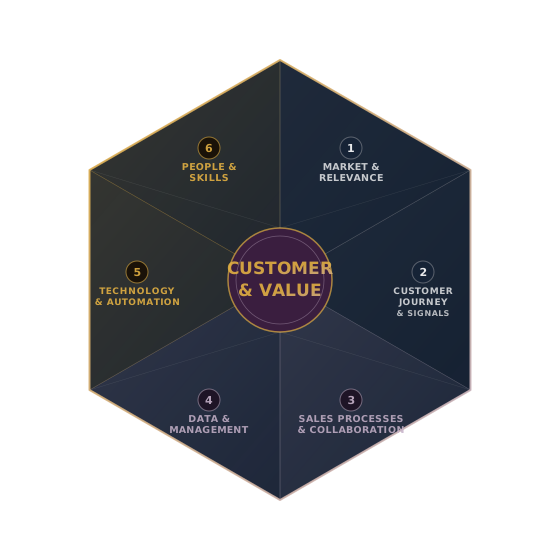
The layers of the framework
Culture & Leadership
CoreThe starting point of every system
Every revenue system is only as good as the decisions made within it. Culture and leadership form the core of our framework: they shape attitudes, ownership and decision quality.
Purpose & Commitment
Direction that guides action
Purpose provides operational direction. Clarity on what a company sells for, and what it does not stand for, creates focus, prioritisation and consistent decisions.
Flow & Structure
Value creation without unnecessary friction
Growth rarely fails because people are not performing. Handovers, silos and unclear responsibilities are often the cause. This layer describes how marketing, sales and customer success work together along the customer journey.
Technology & Automation
including AIAn enabler of better work
Technology and AI should reduce people's workloads. In our framework, technology is a means of increasing clarity, speed and quality in decisions.
Governance & Steering
Leadership that works
Effective management comes from clear goals, decision principles and rhythms. Governance & Steering keep the system manageable without micromanagement or dependence on individuals.
Market Reality
ContextResilience develops through interaction with the market
Sales and revenue systems do not operate in a vacuum. Market mechanisms, buying dynamics and stakeholder structures determine how resilient a system really is. This reality forms the outer context of our framework.
The framework describes the relevant layers of a sales and revenue system.
It provides the basis for concrete deliverables tailored to your organisation's current state and main sources of friction.
What we create
Not every company needs everything. Our deliverables translate the framework into specific outcomes for your situation.
Purpose & Commitment Alignment
Implicit → Effective
We turn strategic intent into everyday decisions, priorities and behaviour.
Typical deliverables
Strategy & Market Reality
Assumptions → Reliable decision inputs
Strategy that holds up against market and buying reality, beyond internal expectations.
Typical deliverables
Flow & Structure
Friction → Seamless flow
Clear processes along the customer journey, with unambiguous ownership at handovers.
Typical deliverables
Governance & Steering
Activity → Effective management
Clear goals, decision principles and management rhythms that enable proactive leadership.
Typical deliverables
Data & Intelligence
Silos → Single source of truth
Data becomes a shared basis for decisions.
Typical deliverables
Technology & Automation
Tools → System
Your tools work together: automated, integrated and thoughtfully supported by AI.
Typical deliverables
People & Enablement
Overloaded → Effective
People can focus on creating impact instead of compensating for gaps in the system.
Typical deliverables
Where do we start?
The starting point is the question of where friction occurs.